
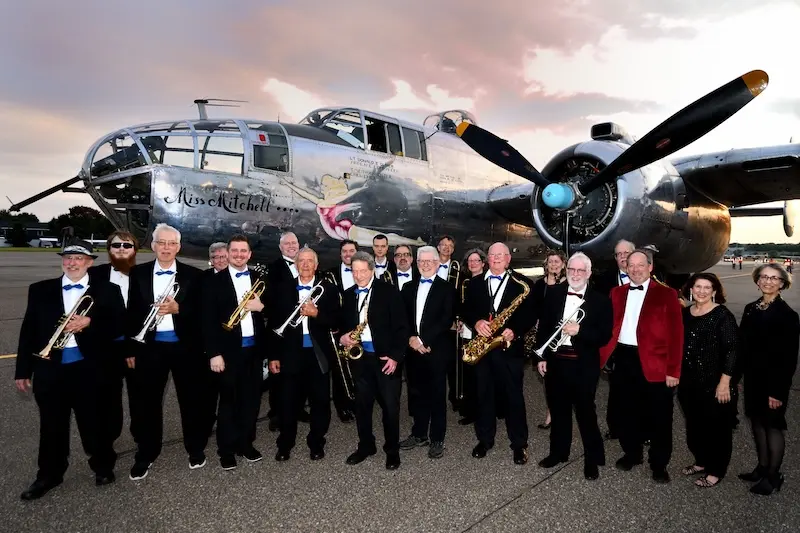
Last Saturday night I had a blast photographing the Roseville Big Band perform at the Commemorative Air Force Fall Bombers Moon Ball. Trying to get more media for the Minnesota Mandolin Orchestra, I thought I’d ask Glen, who performs with both ensembles, if we could swap some photo ops.
Context set, I was nervous during the shoot. I had walked the hanger during the day, but I wasn’t sure about lighting for the night of the shoot. Also, I had misunderstood the timing, expecting to have some time with the band ahead of the performance for a portrait. Actually, that was accurate, but I hadn’t planned for throngs of people arriving early at the hanger.
By the time the band was ready for their photo, there were oodles of people crawling around Miss Mitchell, the aircraft that the band wanted to be photographed with. The sun was low — about 30 minutes from set and directly behind Miss Mitchell. There was a professional photographer already working with plane into his portraits whom I asked for a graceful pause.


Having to work quickly, I had the plan to use a 14-24mm lens and a camera-mounted fill flash and shoot close to crop out visitors. With the sky being so bright, the sun at the back of the plane, and the band dressed in black, I pushed the exposure a full step and clicked as fast as my flash would cycle.
Thirty seconds later, I had my washed-out result, above left. To the punchline, this morning I read that Gemini can edit photos, though not NEF or TIFF today, and after several iterations, mostly of directions to brighten Gemini’s idea of a sunset and not to to distort the subject’s proportions, Google delivered the result on the right.
If you’re not familiar with the band, it might not matter, but I doubt that many family members would recognize them in the AI-edited photo. Sandy walked up behind me and asked, “tuxedos! Is the conductor wearing the red one?” And I realized I couldn’t identify the conductor – actually, I thought he wasn’t present and I swore. Then looking at the faces, things didn’t look right. It was a hassle to brighten Gemini’s result, but I could not persuade Gemini to spare the band face lifts.
There was value to complaining to Gemini. The AI-altered image focused my time spent on the exposure of the original image in NX Studio by giving me a target in my imagination. The center(and banner) image is the result.


